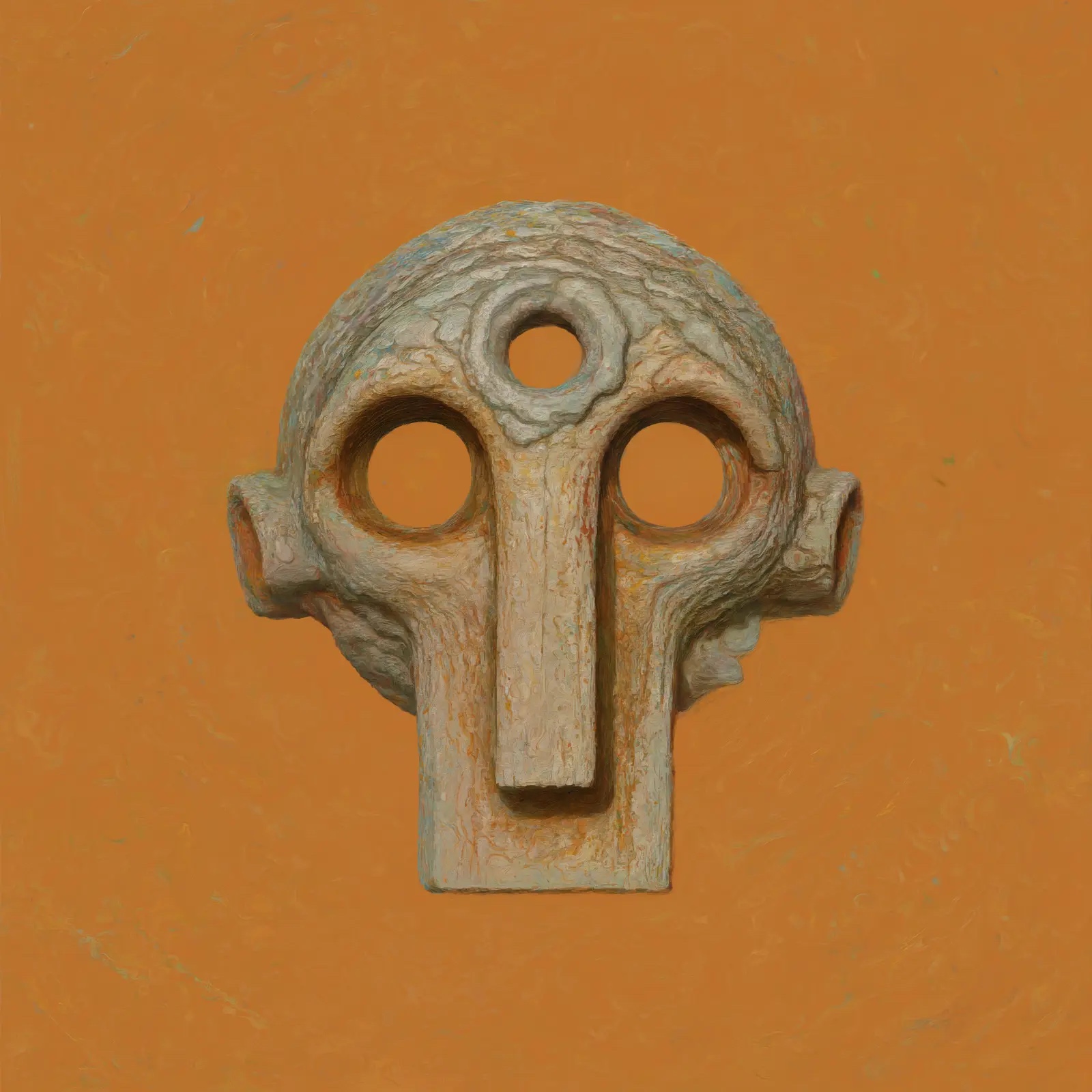
Collecting begins with possession. It becomes culture through responsibility.
An object enters a wallet or home. The transaction establishes custody, but it does not determine what that custody will mean. The work may disappear into private satisfaction, become a speculative position, enter an exhibition, generate scholarship, anchor a community or pass through several lives after its first collector is gone.
The collector chooses among those futures, although never alone.
LUCI makes that choice unusually visible because collectors are already inside the work. Their bids helped sustain its beginning. Their observations became Masks. Their votes and relationships shaped participatory chapters. Their wallet histories became passages in the archive.
The collector is not merely standing beside the mythology. The mythology has recorded the collector as one of its materials.
This creates obligations that ordinary ownership language struggles to express.
The first is attention.
To hold a role in a living work is to keep looking after the acquisition has stopped being new. It means returning to the object, reading its context, noticing changes in one’s interpretation and resisting the market’s pressure to replace sustained attention with the next announcement.
The second is memory.
Digital objects persist technically while their cultural context disappears easily. Links fail. Platforms close. Conversations vanish. Participants forget why decisions were made. Collectors can preserve correspondence, exhibition records, source material, high-quality files and the stories attached to passage.
This is not secondary administrative work. It is part of the artwork’s ability to reach future readers intact.
The third is interpretation.
A collector does not need to become an authorised expert. They do need to distinguish what they know from what they infer. Public interpretation is most valuable when it makes evidence inspectable, names uncertainty and leaves space for disagreement.
Myth needs commentary. It does not need another person claiming to own its final meaning.
The fourth is access.
Scarcity can protect the integrity and value of an object. It can also become a justification for keeping knowledge, opportunity and proximity within the same circle. Collectors can decide whether their access produces more access for others.
They can lend works, support exhibitions, share documentation, introduce thoughtful newcomers, fund preservation, commission writing and make the archive intelligible beyond those already fluent in its social language.
The fifth is recognition.
The Gates of Toledo suggests that attention from outside established ownership can alter the world. Existing participants may therefore have a responsibility to notice contributions that the current hierarchy does not automatically reward.
Recognition is not the same as patronage from above. It is the willingness to let another person’s observation change one’s own map.
The sixth is passage.
Every collector is temporary, even when the blockchain record is permanent. A work will eventually be sold, gifted, inherited, lost or left inaccessible. Treating passage as part of stewardship allows that future to be considered before crisis decides it.
Who should hold the work next?
What context must travel with it?
Can its movement enlarge the mythology rather than merely realise value?
What would make a transfer feel like continuation rather than exit?
These questions do not demand that collectors surrender objects on command. Compulsory generosity is another form of control. Carse insists that play must be voluntary. The cultural meaning of release comes from choosing continuation over permanent possession when the moment genuinely calls for it.
Different collectors will face different forms of the task.
Council members carry institutional memory and the symbolic burden of the first fifty gifts. Their challenge may be converting authority into service, succession or release.
Mask holders carry observations made durable. Their challenge may be living beyond the statement that first defined their role and keeping revision possible.
Skull holders carry seats whose meaning exceeds the image. Their challenge may be treating provenance as a lineage of responsibility rather than a chain of prices.
Painting holders carry the canonical centres around which the wider mythology formed. Their challenge may be making those centres available to the community without reducing them to spectacle.
Newer collectors face the temptation to imitate the founding generation. Their opportunity is different: to contribute what the original structure could not have anticipated.
Non-holders may have the clearest test of all. They can determine whether participation is possible before recognition. If their work remains serious without assurance of reward, they demonstrate that attention itself can be a form of entry.
The artist also remains a participant in this exchange. The Mask Maker creates the conditions, but a mythology made partly from collector voices cannot remain alive if all future meaning is treated as inaccessible intention locked inside its creator.
The artist listens. The collectors answer. The work changes the terms of the next answer.
This reciprocity distinguishes a living world from a brand.
A brand protects consistency. A mythology can survive contradiction.
A brand converts participation into loyalty. A mythology allows participants to return with difficult observations.
A brand treats community as an audience for future products. A mythology treats community as part of the material from which its future is made.
Collectors should therefore resist two equal and opposite errors.
The first is passive ownership: assuming the work’s importance will take care of itself.
The second is self-appointment: mistaking enthusiasm or proximity for authority over everyone else’s interpretation.
The better position is custodial participation.
Custody says: this is in my care, not exhausted by my possession.
Participation says: my actions can change what remains possible.
Together they produce an ethic appropriate to an infinite story.
The finite market will continue. Works will be priced, traded and ranked. Those games are not impurities that must be removed. They provide resources, commitment and historical signals.
But they cannot be allowed to define the purpose of the larger play.
In a finite market, significance comes from acquiring what others cannot.
In an infinite story, significance may come from helping others enter what you helped preserve.
That is what LUCI may now be asking its collectors to become: not owners who stand at the end of the work, but custodians positioned somewhere in the middle of its passage.