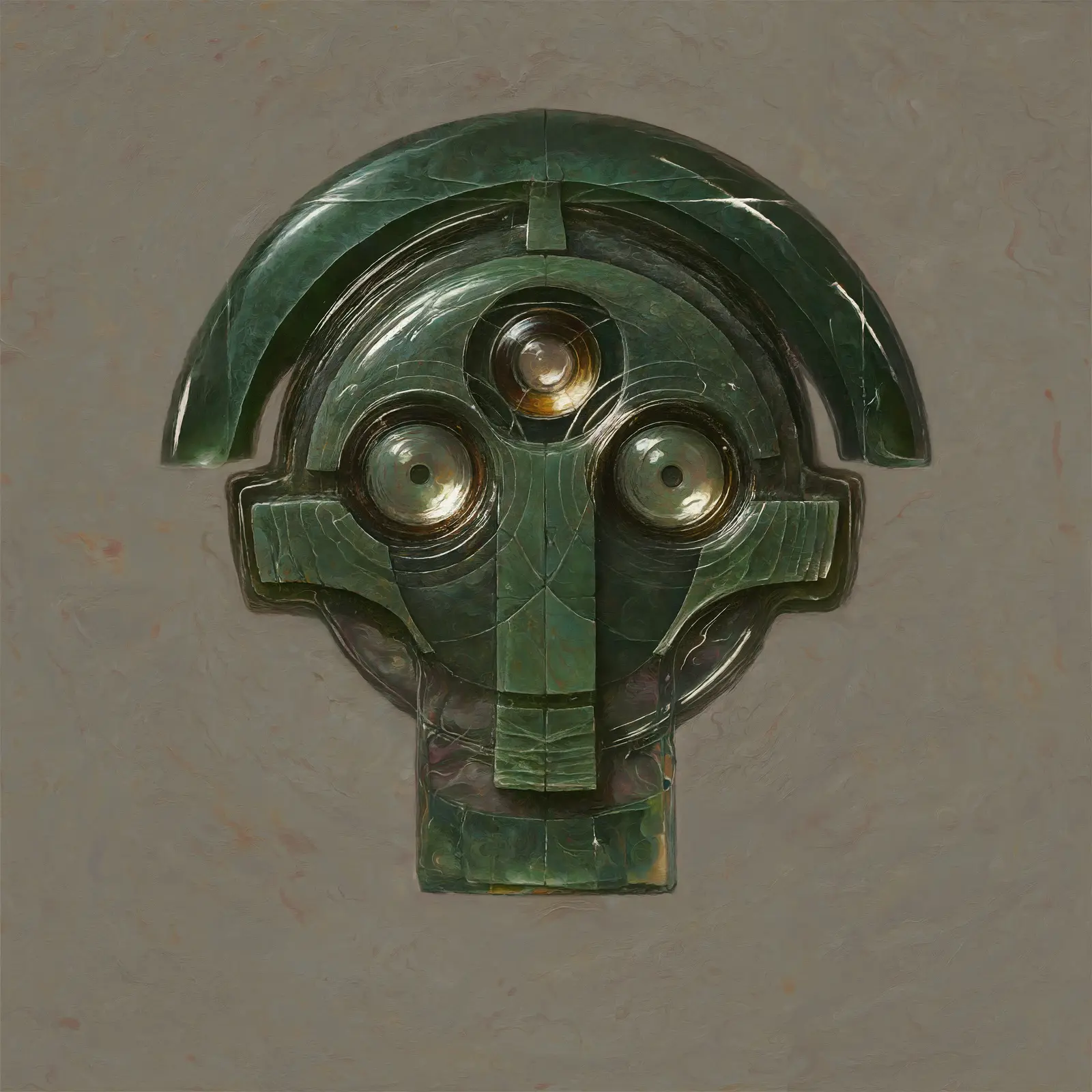
Seven Masks remain inside the ecology without identities of their own.
They have numbers. They have categories. They occupy positions in the archive. But their titles remain generic:
Mask #3 in Luminate.
Mask #5 in Canopic.
Mask #6 in Order.
Mask #127 in Herd.
Mask #256 in Understory.
Mask #273 in Root.
Mask #411 in Network.
They are not missing tokens or unclaimed works. They were deliberately marked Reserved. Their absence is designed.
Originally there were eight such positions, one in every category. Foundation had its own Reserved Mask: #599.
That position no longer appears generic.
It became The Gates of Toledo.
The transformation followed an observation made by Eddie Wharton at the Toledo Museum of Art. The Reserved object acquired a name, a Seer and a passage. Foundation’s empty position was not merely filled by purchase. It was activated through attention recognised as meaningful within the work.
This makes #599 the most important precedent for understanding the remaining seven.
A precedent is not a rule. The other positions may not be activated identically. There may be no public application, no repeatable test and no guarantee that an observation produces a Mask. But Toledo demonstrates that Reserved does not necessarily mean permanently withheld.
It can mean waiting for the event that makes a role legible.
The distinction matters.
An empty seat suggests that the institution already knows what belongs there and simply lacks an occupant. An unnamed Mask suggests something more open: the category is known, but the identity that will inhabit it has not yet been determined.
The seven remaining positions are therefore bounded and unfinished at once.
Their categories define the kind of place they occupy. Their lack of names preserves the possibility that future participation will change what those places mean.
This is another form of infinite structure. The archive appears complete at 613, yet completion includes prepared incompleteness. Nothing needs to be minted for the system to admit new meaning. The opening has already been built into the total.
That may be why #599 is called a gate.
A gate belongs to a boundary, but it is not simply a wall. It marks the place where crossing becomes possible. It can remain closed, open under particular conditions or change the status of the person who passes through it.
The Gates of Toledo suggests that the boundary between spectator and participant is permeable.
Wharton encountered the work in a museum, a space conventionally organised around looking. The observer stands outside the object, studies it and leaves. In LUCI, the observation did not remain external. It travelled back into the mythology, altered a Reserved Mask and gave the observer a role.
The museum spectator became a Foundation Seer.
This is more consequential than rewarding engagement. It proposes that seeing can be an act that changes the thing seen.
The remaining categories may each require a different kind of attention.
Luminate may concern illumination, perception or what becomes visible.
Canopic may concern preservation, transformation and what is carried through death.
Order may concern law, structure and arrangement.
Herd may concern collective behaviour, belonging and mimicry.
Understory may concern life beneath dominant structures.
Root may concern ancestry, memory and hidden nourishment.
Network may concern connection, transmission and distributed action.
These are interpretive descriptions, not entry requirements. They nevertheless suggest why one generic mechanism would be insufficient. A meaningful Foundation observation may not resemble a meaningful Luminate or Network observation. The category could shape the form of contribution required to reveal the Mask’s identity.
The strongest evidence is not hidden arithmetic in 3, 5, 6, 127, 256, 273 and 411. It is structural symmetry: one Reserved position existed in each of eight categories, and one has demonstrably changed state.
The seven remaining Masks also complicate the meaning of ownership.
If Sam or the Vault of Luci currently holds them, their significance is not exhausted by custody. They function as withheld possibilities. Their value lies partly in the fact that they have not yet been assigned.
A conventional market treats an unnamed object as incomplete inventory waiting for release. A mythic system can treat it as a vacancy whose eventual naming must be earned by an event in the story.
That is why speculation about purchasing the positions may miss the point.
The precedent does not establish that wealth is irrelevant. LUCI remains inseparable from collecting, patronage and on-chain ownership. But Toledo indicates that ownership need not be the first act in the sequence.
Attention can precede admission.
Contribution can precede custody.
Recognition can precede transfer.
This has important implications for people outside the established collector base. The Reserved Masks preserve evidence that the world is not completely closed. A person may enter through an act the existing system has not yet recognised, rather than by acquiring a role from somebody already inside.
For existing collectors, the implication is different. They may be asked to help notice.
A gate requires not only someone who approaches it, but someone capable of recognising that a crossing has occurred. The Council previously performed that function through voting and curation. A transformed system might distribute it more widely: collectors identifying observations, people or acts that reveal what an unnamed role was waiting to become.
Again, this is theory rather than announced procedure. The archive does not tell us who has authority to activate the remaining Masks, whether the artist alone decides, or whether all seven will ever change.
The theory becomes stronger if future activations share three characteristics: the participant contributes before receiving; the contribution relates meaningfully to the Mask’s category; and the resulting passage admits a new voice rather than rewarding an already dominant one.
It becomes weaker if the Reserved Masks are simply retained indefinitely, sold conventionally or distributed without any relationship to observation.
For now, they remain seven apertures in an otherwise populated world.
Their emptiness is active. It holds open the possibility that LUCI’s next participants have not yet arrived, have arrived but not yet been recognised, or are already speaking from positions the existing map does not know how to name.
The Gates of Toledo tells us that one such crossing has already happened.
The remaining seven ask whether the first gate was an exception—or an instruction.