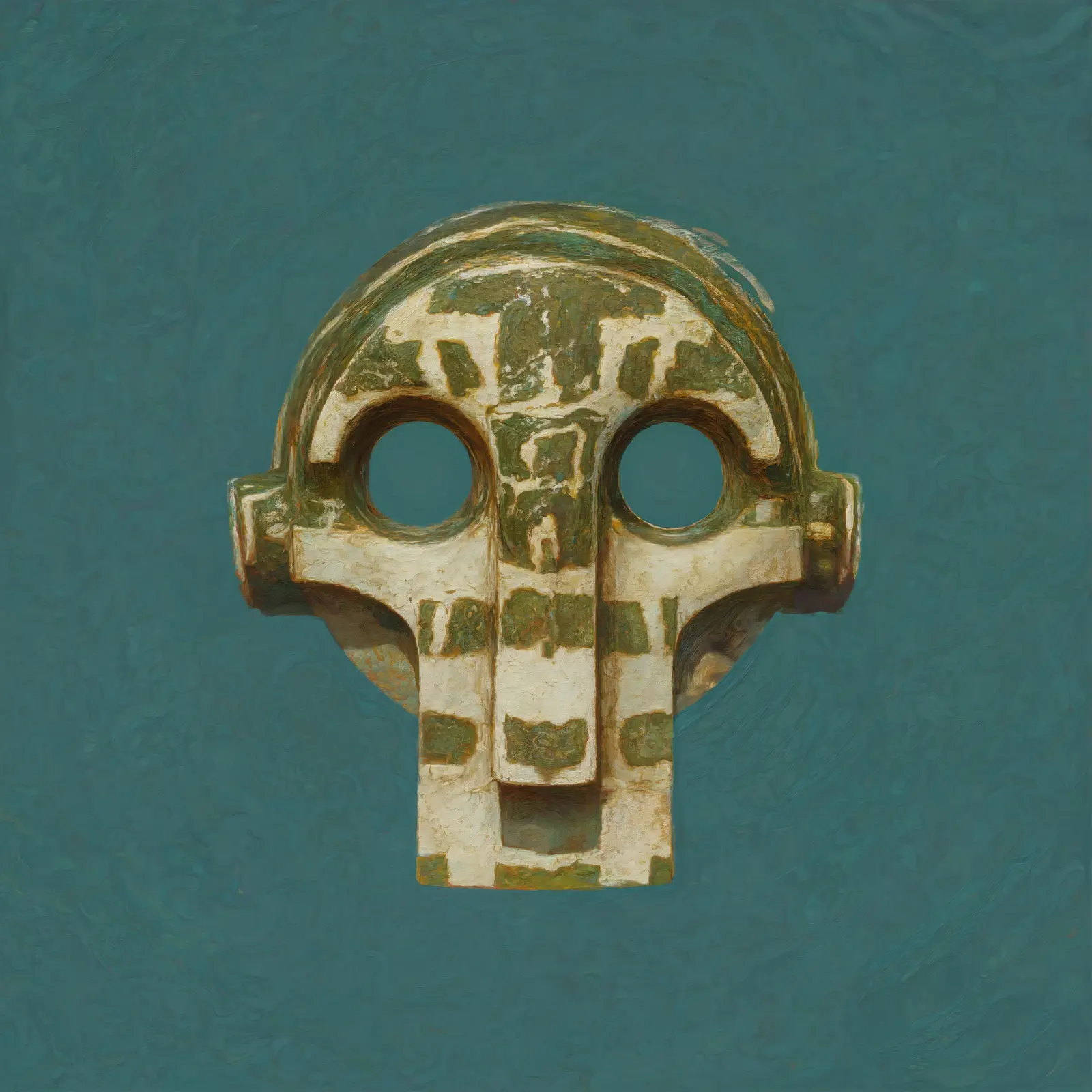
Jubilee is not simply a celebration.
It is an interruption.
In Leviticus, seven cycles of seven years are counted. Forty-nine years accumulate. The fiftieth year is then set apart as Jubilee: liberty is proclaimed, land is allowed to rest, people return to families and ancestral holdings, and relationships shaped by loss and dependency are reset.
The exact historical practice is complex. Debt release is more directly associated with the recurring seventh-year provisions elsewhere in the Hebrew Bible, while Levitical Jubilee emphasises liberty, return and the restoration of land. Yet Masquerade does not name an ordinary Jubilee. It names a Debt Jubilee, joining release from obligation to the fiftieth-year structure of return.
That makes the number fifty impossible to treat casually.
There are fifty Skulls of Luci.
There are fifty Council members.
There are fifty Masks paired with those Skulls.
The Council itself began as the repayment of a debt of gratitude. The Skulls were created to thank every person who had placed an offer on the first three LUCI paintings. They were gifts before they became seats, and seats before they became a recognised Council.
Then, in 2025, each Skull received a paired Mask: another gesture of thanks, this time for the labour the Council had contributed through years of advice, curation and voting.
Gratitude has therefore been repaid twice through objects.
First Skull, then Mask.
The language of debt is already embedded in the Council’s origin.
Masquerade ends by turning that private history into a public promise. The Mask Maker readies beneath the Zoo to craft again “For the Debt Jubilee.” Elsewhere among the 613 sits Mask #596, Jubilee Countdown. The archive does not explain what is being counted down or specify a date. The title nevertheless confirms that Jubilee is not incidental decoration. It is a pending condition within the world.
The seven-times-seven structure connects several otherwise separate clues.
Mask #258 asks what seven means.
Mask #250, Infinite Games, answers with the rules of Chapter Seven.
Seven generic Reserved Masks remain after the activation of the Foundation position.
The Council contains fifty seats.
And Masquerade announces Jubilee.
None of these correspondences proves a single mechanism. But together they establish a grammar: seven marks a cycle; fifty marks release after accumulation.
What has accumulated?
Ownership, certainly. The earliest works and seats have passed through markets and private collections. But LUCI has also accumulated reputation, access, authority, memory and obligation. Early participation became a durable form of distinction. The Council acquired influence because its members repeatedly gave time, attention and support. Collectors built histories around objects whose cultural importance grew alongside the artist’s.
Accumulation is not presented here as a moral failure. Without it, the work might not have survived long enough to develop a mythology.
Jubilee becomes necessary not because the past was illegitimate, but because a successful past can close the future.
If positions acquired during the founding moment become permanently decisive, later participants can enter only as spectators or purchasers. They may own objects, but they cannot meaningfully alter the structure. The community begins to reproduce the exact hierarchy that its history created.
The biblical imagination of Jubilee interrupts that process. It acknowledges that legitimate transactions can still produce conditions requiring reset. A debt may have been real. A transfer may have been lawful. A hierarchy may have emerged from genuine contribution. Jubilee does not erase history; it prevents history from becoming destiny.
Applied to LUCI, this suggests that the coming release may concern roles as much as assets.
The Council’s prior authority may be returned to the field.
Reserved positions may be opened.
Collectors may be asked to nominate, sponsor or recognise participants who do not yet hold equivalent status.
A Skull or Mask may pass to another custodian.
A right may become a responsibility.
An institution formed around gratitude may be required to express that gratitude outward.
These are possibilities, not announced rules. Nothing in the archive currently establishes that a Council member must surrender a token, that holdings will be redistributed, or that the seven Reserved Masks will be awarded through a single process. Jubilee is a powerful interpretive key precisely because it names a principle without yet revealing an implementation.
The principle is release from accumulated finality.
This distinguishes Jubilee from another reward cycle. A conventional sequel would increase scarcity, add benefits to established positions or conduct a new contest under familiar authorities. A Jubilee worthy of the name would alter the relationship between possession and participation.
It would ask not who deserves more, but what must circulate again.
For collectors, this can feel threatening. A market trains its participants to protect scarcity. Cultural significance is often measured through difficulty of access. The longer a person has held an important work, the more its history becomes entangled with their identity.
Jubilee introduces a different measure.
The significance of a position may lie in its capacity to produce passage.
This does not require abandoning stewardship. In fact, passage without stewardship is merely turnover. The collector’s task may be to preserve an object carefully enough that its eventual movement carries meaning rather than erasing it.
The Council’s provenance records already use the language of passage. A seat is held, then passed. The object remains identifiable across custodians. Its history becomes richer because the record contains both continuity and change.
Jubilee could enlarge that principle from individual transfers into a transformation of the system.
A true Debt Jubilee would also complicate the relationship between Sam and the Council. The original gift repaid early support. But gratitude can never be conclusively settled by an object. The Skull generated a Council; the Council generated labour; the labour generated paired Masks; the Masks now generate new obligations of interpretation and custody.
Every repayment created another relationship.
This is exactly how an infinite game treats debt. The aim is not to close the ledger. It is to convert obligation into continued reciprocity.
The phrase Debt Jubilee may therefore contain a paradox.
Debt suggests something owed because of the past.
Jubilee creates freedom from the past’s permanent claims.
The next chapter may require both acts at once: remembering who carried LUCI here while refusing to let that memory decide forever who may carry it next.
That is why fifty matters.
Fifty is not merely the size of the Council. It is the point at which accumulation becomes return.
If seven describes the cycle, the fiftieth position describes the threshold beyond it.
The Council’s greatest repayment may not be another object received from the artist. It may be the opportunity to release the mythology from dependence on its founding circle.
And the Debt Jubilee may be the moment when gratitude stops moving inward and begins to travel out.