The Council did not begin as a council.
It began as thanks.
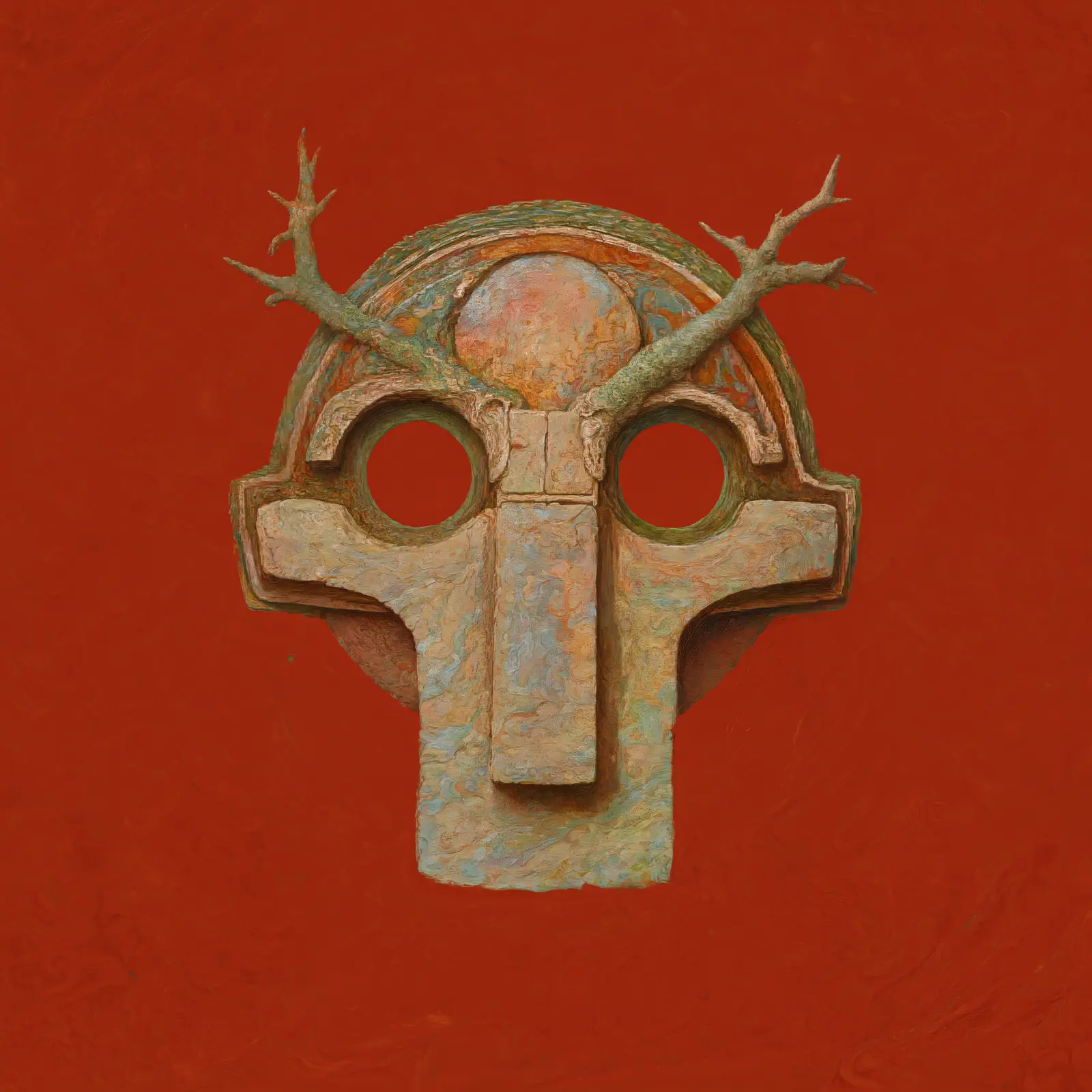
After the first three LUCI paintings, Sam Spratt made the Blueprint Skull and then derived forty-nine more. One went to every person who had placed an offer on Birth of Luci, Lullabies for Isaac and First Sacrifice. Fifty early bidders received fifty Skulls.
The gesture preceded the institution.
Sam’s account is unusually clear on this point. The Skulls were not designed as governance tokens or badges of formal status. They were gifts that grew into something else. The inner circle formed around the gesture rather than the gesture being invented to legitimise an inner circle.
This origin matters because it keeps two histories alive at once.
In the first history, the Council is a record of gratitude. Fifty people were present early enough, and acted decisively enough, to help create the material conditions in which LUCI could continue. The Skulls recognised that support. Their scarcity was not originally a competitive rule imposed upon a future community; it was the shape of a particular historical moment.
In the second history, gratitude gradually became office.
Council members advised the artist, worked together, gathered in his studio, curated recipients of Players and Masks, and voted on participatory chapters including The Monument Game and Masquerade. A personal gesture acquired collective functions. Those functions became part of the machinery through which later participants entered the work.
Neither history cancels the other. The Council can be both gift and institution, friendship and authority, gratitude and hierarchy.
That doubleness is central to what may come next.
Institutions rarely begin by announcing themselves as institutions. They form through repeated acts of trust. A person is asked for advice because their judgement matters. They are asked again because the first exchange worked. Informal consultation becomes expectation; expectation becomes role; role becomes a structure visible to everyone outside it.
The Council’s history shows that process in miniature:
offer becomes gift;
gift becomes relationship;
relationship becomes deliberation;
deliberation becomes authority;
authority becomes a recognised class.
The transformation need not involve corruption or bad intent. It is what successful social structures do. They stabilise.
But stabilisation creates a problem for an infinite game. The people who helped a world begin can become the permanent boundary around who is permitted to shape it. Historical contribution turns into inherited legitimacy. Later participants may be invited to speak, but the power to recognise their speech remains concentrated among those who arrived first.
Masquerade both used this structure and exposed it.
The Council helped evaluate observations and determine outcomes. In 2025, a Mask was made to pair with each Skull—a continuation of the original gesture of gratitude and recognition of the hours Council members had spent voting over the years.
All fifty Skull names reappear among the 613 Masks.
Yet the Council Masks are treated differently from almost every other Mask. They have no ecological category. They do not belong to Luminate, Canopic, Order, Herd, Understory, Root, Network or Foundation.
They stand outside the forest.
This exclusion may be ceremonial. It distinguishes the Council as a special class. But it also describes the logic of its previous function. To classify and judge the inhabitants of a system, the Council had to occupy a position that appeared external to that system.
The forest contains roles.
The Council assigns them.
That is the arrangement of a finite game. Players act within the field; judges stand at its edge and recognise outcomes.
The categoryless status of the Council is therefore not simply elevated rank. It may be evidence of incomplete belonging. The Council helped populate the ecology without being given an ecological place of its own.
That ambiguity becomes sharper beside Sam’s statement that its role in the next chapter will be unlike anything it has done before.
The least consequential reading would be that Council members will judge a different kind of contest. The subject changes, but the relation remains intact: Council outside, players inside.
The more consequential reading is that the relation itself must change.
If the next phase operates as an infinite game, the Council cannot remain permanently external to the play. The referees must enter the field. Authority must be converted into participation, service, passage or risk.
This does not require hostility towards the Council. It may require the opposite: taking its founding story seriously.
The Skulls began as repayment of gratitude. Their meaning came from reciprocity, not domination. A transformed Council could return to that origin by becoming the mechanism through which gratitude travels outward.
Council members might sponsor entry, recognise overlooked observers, transmit knowledge, accept new obligations or release privileges that have outlived their original purpose. They might become direct characters within an event rather than its adjudicators. Their seats might function less as permanent offices and more as passages carried between custodians.
The site’s provenance language makes that final possibility especially suggestive. Skull histories are recorded as passages. A passage is not merely a sale. The word frames transfer as movement through a role. The object remains, but its custodian changes.
This offers a different conception of continuity. An institution can survive by preserving the same people in the same positions. Or it can survive by developing a form strong enough to pass through different people.
The first is continuity of membership.
The second is continuity of purpose.
An infinite Council would need the second.
There are reasons for caution. The archive does not state that Council members must transfer their Skulls or Masks. It does not announce the dissolution of the Council. It does not specify that a seat can be earned through observation. “Unlike anything they’ve done before” is a promise of difference, not an explanation of its mechanism.
The aim is therefore not to convert suggestive language into a prediction of particular token movements.
The stronger conclusion is structural.
The Council began as an answer to a debt of gratitude. It became the body that judged finite games. Its fifty paired Masks now stand outside the ecology. The next chapter promises to transform its role. Masquerade closes by naming a Debt Jubilee.
Those facts place the Council at the centre of the threshold.
The question is no longer whether its members deserve their historical significance. The archive already records that significance.
The question is what historical significance demands next.
Does early support entitle a person to permanent authority? Or does it create a deeper obligation to keep the world open after one’s own place within it is secure?
This is where gratitude and Jubilee meet.
Gratitude remembers who made continuation possible in the past.
Jubilee asks what must be released so continuation remains possible in the future.
The Council may not be approaching its destruction. It may be approaching the end of one interpretation of itself.
The people can remain while the role dies.
The gift can remain while the authority it accumulated is redistributed.
The history can remain while its meaning changes from possession to passage.
If that is the next move, the Council’s most important act will not be another judgement. It will be demonstrating that even the highest role in LUCI is still capable of becoming something it has never been before.