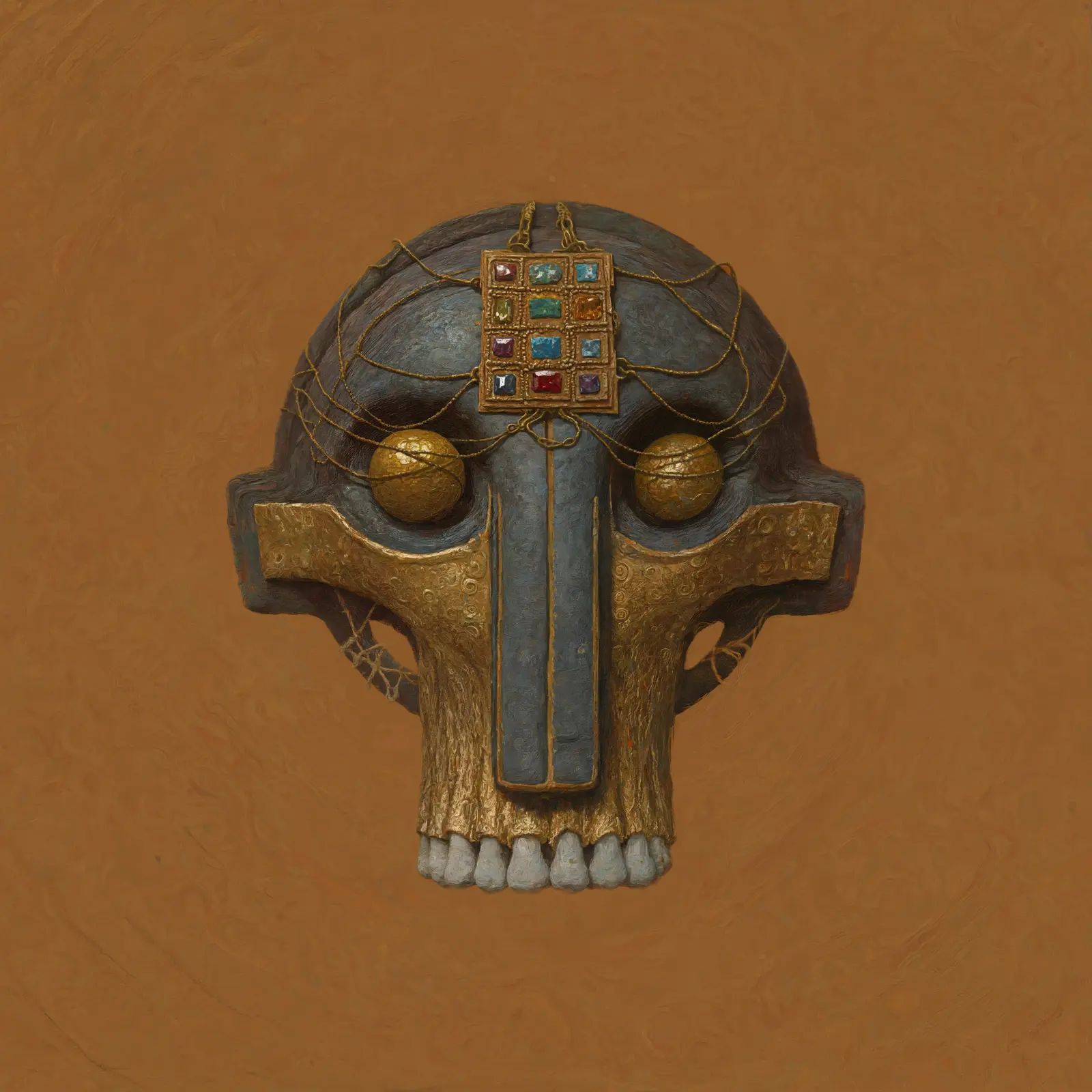
The number 613 arrives carrying the weight of completion.
In Jewish tradition, 613 is conventionally understood as the number of mitzvot: the commandments gathered from the Torah. That does not prove that each Mask corresponds to a particular commandment, nor that Masquerade should be read as a coded reproduction of Jewish law. LUCI is syncretic, and its symbols migrate between biblical, ecological, philosophical and personal registers.
But choosing exactly 613 Masks places the work in the vicinity of law.
A commandment is not only a statement. It is an instruction that becomes meaningful through performance. It assigns obligations, organises relationships and turns inherited text into present conduct. A Mask can operate similarly. It names an observation, gives it a body and places its holder within a network of possible actions.
This is why the 613 should be understood as more than a supply.
Masquerade gathered voices, but it also classified them. Each Mask received attributes: category, region, rank, attendee type, coordinates, observations, replies and revisions. Together they form something between a census, a cast list, a taxonomy and a map.
The category counts reveal a deliberately constructed ecology.
Luminate contains 43 Masks.
Canopic contains 55.
Order contains 64.
Herd contains 68.
Understory contains 78.
Root contains 79.
Network contains 83.
Foundation contains 90.
From light towards bedrock, the population generally grows. The visible upper layer is sparse. The deeper supporting layers hold more bodies. This is not merely a set of aesthetic labels. It presents the community as a forest whose most populated structures are those least visible from above.
The eight categories contain 560 Masks in total.
That leaves 53 outside the ecological taxonomy.
Fifty of those are the Masks paired with the fifty Skulls of the Council. Council Masks have no category. They are not Luminate, Canopic, Order, Herd, Understory, Root, Network or Foundation. They stand outside the forest’s system of belonging.
The final three are Masks of Creation, Destruction and Balance.
The arithmetic is exact:
560 within the ecology.
50 Council Masks outside it.
3 governing or exceptional Masks.
613 altogether.
This division gives the assembly an internal constitution.
The 560 belong to the inhabited world. The Council occupies an exterior position from which it has historically advised, curated and judged. Creation, Destruction and Balance appear less like ordinary inhabitants than principles capable of altering the system itself.
That reading is interpretive, but it begins from a verifiable structural fact: the Council and the final triad are treated differently by the metadata.
The attendee ranks offer another view. Most Masks belong to Masked Players and Masked Guests. Eight positions were originally marked Reserved, one within each category. One of those positions later became The Gates of Toledo, leaving seven generic Reserved Masks. The categories therefore did not begin as completely sealed populations. Each contained a deliberate absence.
An empty role is not the same thing as a missing object.
The Reserved Masks already existed. They had numbers, category positions and places in the map. What they lacked was the observation that would give them an identity.
This makes the 613 feel less like a completed portrait of a community and more like a prepared dramatic structure. Most roles have been named. Some stand outside the system. Others remain present but unfulfilled.
The Masks also preserve a distinction between observation and revision.
Participants first supplied words in response to the work. Later they were allowed to return to those words. The revision did not erase the earlier encounter; both stages remained part of the archive. The mythology records not only what a person saw, but how that person changed after seeing themselves recorded.
This matters because a living interpretive tradition depends upon revision. A statement fixed forever at the moment of first contact becomes testimony from the past. A statement revisited becomes evidence of continuing relationship.
The Mask is therefore both identity and interval. It holds a version of the participant at one moment and the distance travelled by the next.
That resembles the structure of commentary. A canonical object remains available. A reader responds. The response becomes part of the record. Later readers encounter both the originating work and the history of its reception. Meaning accumulates without becoming identical to any one contribution.
The archive makes that accumulation unusually literal. Collectors’ words are not displayed merely beside the artwork. The Masks were made from the observations. Interpretation is converted into object, title, material and role.
This has consequences for the idea of collecting.
A conventional collection organises objects around the collector. The collector selects, owns, displays and contextualises them. Masquerade reverses the direction. The collector’s observation is selected, shaped and placed inside the artist’s world. The observer is collected by the mythology.
The 613 may therefore be a census of people who believed they were studying LUCI, only to discover that LUCI was also studying them.
That inversion explains the persistent language of witnessing, attention, masks and roles. The question is not simply whether the observation was correct. It is what the observation disclosed about its maker, and what function that disclosure might later serve.
If the number 613 evokes law, the Masks do not read like a list of prohibitions. They resemble a law of participation: six hundred and thirteen ways of seeing made available as six hundred and thirteen ways of entering the story.
This does not make all Masks equivalent. The taxonomy preserves difference. Categories, ranks, regions and relationships matter. Nor does it make ownership incidental. The work’s on-chain existence gives custody, passage and lineage a durable form.
But the structure complicates any reading in which ownership is the final purpose. A law exists to be enacted. A role exists to be inhabited. A witness exists to testify. A path exists to be walked and transferred.
The decisive question is whether the 613 are retrospective or prospective.
If they are retrospective, they commemorate Masquerade. They are the final artefacts of a completed event: an extraordinary record of who participated and what they saw.
If they are prospective, Masquerade was an act of preparation. It assembled the roles, established the ecology and distributed the pieces required for later play.
Several signals favour the second possibility.
The Council’s next function remains pending.
The Mask Maker is said to be preparing to craft again.
The Debt Jubilee is announced in future-facing language.
Reserved category positions remain unnamed.
Creation, Destruction and Balance sit outside ordinary classification immediately before the final Mask.
None of these clues reveals a mechanism. Together they make simple completion difficult to accept.
The 613 may be complete as a number while remaining incomplete as an action.
This is the paradox at the centre of the archive. Everything appears accounted for, yet the classification itself preserves absences. The law has been written, but not fully performed. The cast has assembled, but some actors do not yet know what their roles require.
For collectors, this changes the meaning of the object in hand.
A Mask may record why you were admitted. It may also ask what your admission now makes possible for somebody else.
The difference is the distance between possessing a place in the story and helping the story continue beyond the people who currently possess it.