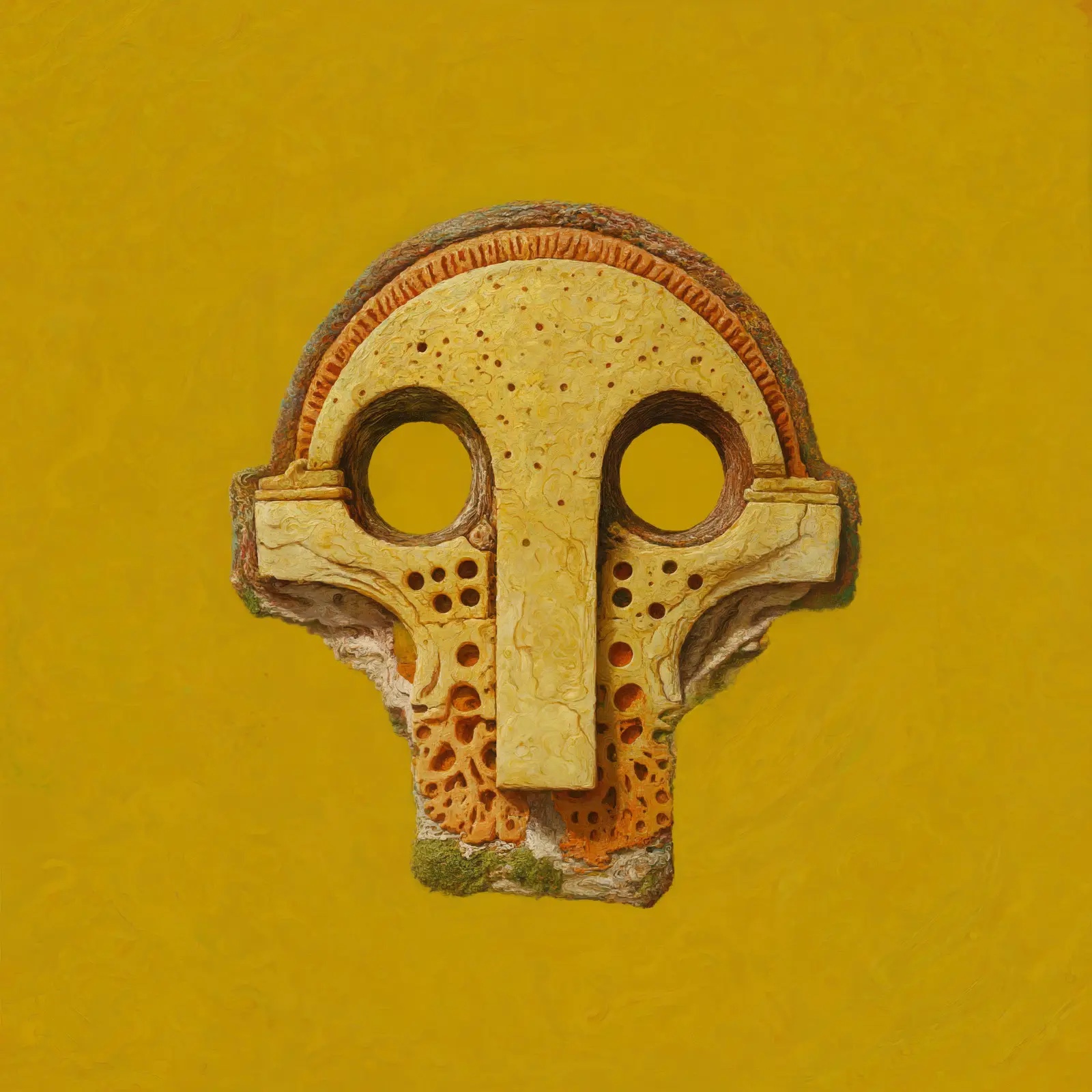
There are two ways to hold a Mask.
The first is as the result of a completed contest. A particular object exists in a fixed supply. It has an owner, a token number, a provenance and a place within a ranked system. Its acquisition records something that happened: a bid placed, an observation chosen, a vote won, a transfer completed. The object becomes evidence of a past victory.
The second is as a role inside a story that has not finished. Here the Mask does not merely certify what its holder achieved. It creates a question about what the holder will do next.
The difference between those two positions is the difference James P. Carse draws between finite and infinite play.
A finite game is organised around a conclusion. Its participants must be identifiable. Its boundaries must be recognised. Its rules must remain stable long enough for everyone to agree that somebody has won. The title awarded at the end—champion, collector, councillor, seer—looks backwards. It names an achievement that can now be entered into the record.
An infinite game is organised around continuation. It does not eliminate finite contests; it contains them. Wins and losses become episodes rather than endings. When the existing rules threaten to exclude everyone except a permanent class of winners, the rules must change. The point is not to abolish distinction, excellence or commitment. It is to prevent those distinctions from closing the field forever.
LUCI has always needed finite games.
The auctions placed the first works. The Monument Game established a bounded field of players and produced recognised outcomes. Masquerade invited observations, imposed deadlines, used a Council and selected recipients. The blockchain itself is a powerful machine for finite facts: this wallet holds this token; this passage happened at this time; this edition contains this many works.
Without those boundaries, there would be no body to the mythology. Attention would dissipate. Participation would leave no trace. The finite structure gave people reasons to arrive, commit and care.
But a structure that gathers a community can eventually prevent that community from changing.
Early arrival becomes permanent legitimacy. Ownership becomes presumed authority. A gift becomes an office. An office becomes a hierarchy. The audience begins to believe that the meaningful roles have already been assigned. Newcomers are reduced to purchasing positions created by earlier participants. A mythology that once attracted interpretation becomes a market for access to interpretations already made.
This is the danger that the infinite game addresses.
Carse’s distinction is especially useful in the context of religion. Religion can become a finite contest when it defines a complete doctrine, a final victory, an exclusive membership and a class authorised to pronounce the meaning of the story. But religious tradition can also operate infinitely. A canon may remain fixed while commentary continues for centuries. Rituals are repeated without being exhausted. Each generation receives roles it did not invent, inhabits them under new conditions and passes them onward altered.
The closest parallel to LUCI is therefore not religion as compulsory belief. It is religion as a living practice of myth, ritual, commentary and custody.
In such a tradition, the founding story is not solved. It is returned to. Its gaps are not defects to be eliminated but openings through which later participants enter. A text can be stable while its interpretive life remains unfinished.
Carse’s Chapter Seven calls this the condition of myth. Myth provokes explanation but does not accept any explanation as its termination. It remains significantly unresolved. A strong interpretation does not silence the next speaker. It gives the next speaker more to answer.
That describes the most unusual feature of Masquerade.
The collector’s observation did not remain outside the artwork as criticism, caption or audience response. It entered the work. It was revised, named and embodied as a Mask. The mythology absorbed the act of interpretation and returned it as new material to be interpreted.
The movement is circular:
Artwork becomes observation.
Observation becomes Mask.
Mask becomes role.
Role produces further observation.
Nothing in that sequence requires a final explanation. Its value comes from continuation.
This also changes how we should understand authorship. Sam remains the artist and Mask Maker, but LUCI’s mythology is no longer made from his images and words alone. The archive describes a world woven between paintings, Psalms and collector voices. The participants do not replace the artist. They become material through which the artist’s world continues to develop.
That is closer to a religious commentary tradition than to a conventional audience relationship. The original works function as a kind of canon. The observations function as testimony and interpretation. The revisions resemble a second reading: the participant encounters their own words again and alters what they are willing to leave in the permanent record. The Masks then make those interpretations available to future readers who were absent from the original event.
The result is neither decentralised authorship in the simplistic sense nor a closed work controlled entirely from above. It is a structured exchange between origin and response.
This is why Mask #250 matters.
Its title, Infinite Games, turns the reply “Rules of Chapter 7” into more than an isolated remark. Carse’s seventh chapter is concerned with myth’s refusal of closure. The reference does not tell us the rules of Sam’s next event. It tells us what kind of rule would be consistent with an infinite mythology.
Such a rule would widen participation rather than permanently defend eligibility.
It would transform roles that have hardened into status.
It would make inherited position answerable to present action.
It would allow the story to absorb surprise.
It would reward contributions that create further possibilities rather than explanations that claim to end discussion.
Under this reading, the Council’s situation becomes especially important. Its earlier function was finite by design. Council members advised, curated and voted. They helped identify recipients and winners. They stood partly outside the field so that they could judge events within it.
But a referee cannot remain outside an infinite game forever. If the Council’s next role is genuinely unlike anything it has done before, the most consequential change would not be another round of voting. It would be the collapse of the distance between judge and participant.
The same applies to collectors more broadly. In the finite version of LUCI, the collector’s primary action is acquisition. In the infinite version, acquisition may be only the beginning of a responsibility: to observe, interpret, preserve, connect, transmit or eventually release.
This does not mean that every holder must surrender a work, that ownership is unimportant or that all participation becomes equal. Those would be claims about mechanics for which we do not yet have evidence. Infinite play is not the absence of form. It is form made capable of change.
Nor does this framework mean that every riddle must remain unsolved. LUCI contains ordinary finite puzzles. A concealed wallet can be found, opened and emptied. A cipher can yield a sentence. A contest can name a winner. What matters is whether solving one finite game creates more attention, more interpretation and more participants—or persuades everyone that the larger work is over.
The hidden wallet attached to the Masks offers a useful example. It had a secret, a reward and an eventual claimant. That game ended. Yet the search trained participants to examine the archive closely, compare observations, decode unfamiliar material and collaborate. The finite game ended while the capacities it produced remained available to the infinite one.
This is where we appear to be now.
Masquerade has finished as an event. It persists as an archive. The 613 are no longer submissions awaiting judgement; they are roles awaiting interpretation. Seven category positions remain Reserved. The Council is promised a different function. The Mask Maker readies again. The closing language points towards a Jubilee: not another accumulation, but some form of release, return or reset.
These signals do not reveal what comes next. They tell us what kind of transition to watch for.
If the next chapter merely repeats the same bounded contest with the same authorities and produces another final class of winners, the infinite-game reading will weaken.
If existing roles are transformed, new participants enter through meaningful contribution, authority becomes service, or ownership creates an obligation of passage, the reading will strengthen.
That makes this interpretation testable. It is not a prophecy protected from contradiction. It is a map against which future events can be compared.
The question for collectors is therefore more demanding than whether another drop is coming.
A finite player asks: What can I win?
An infinite player asks: What must remain possible after I have played?
LUCI may now be moving from the first question to the second. If so, the Masks are not simply the prizes left behind by Masquerade.
They are how the next game learns who is willing to continue it.