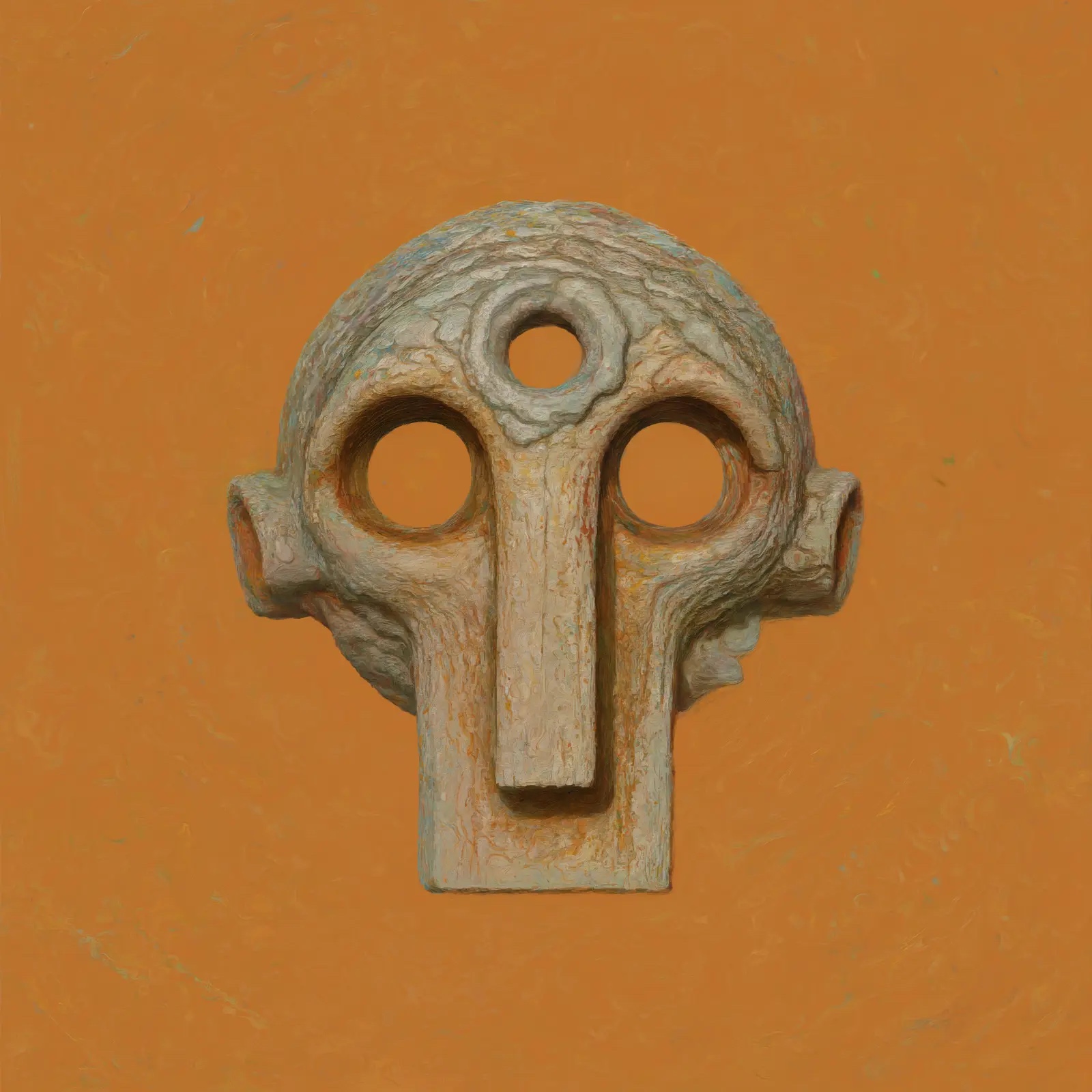
Masquerade looks complete.
The players were selected. The observations were submitted, revised and judged. Six hundred and thirteen Masks were made. Their names, ranks, regions and categories now sit inside a permanent archive. The winners have been named. The objects have owners. If this were an ordinary game, there would be little left to do except preserve the record and argue about which outcomes mattered most.
But LUCI has never behaved like an ordinary game.
A puzzle asks to be solved. Its clues narrow towards an answer, and the arrival of that answer ends the search. A myth behaves differently. It may provoke explanations for centuries without surrendering itself to any one of them. Each serious interpretation returns the story to circulation. Each participant notices something the last one could not. The story survives by remaining larger than its explanations.
One exchange among the Masks gives us a language for this distinction. Mask #258, Page Keeper, asks what the number seven means. Mask #250 answers: “Rules of Chapter 7.” The title of Mask #250 is Infinite Games.
That title points towards James P. Carse’s Finite and Infinite Games. Carse begins with a simple distinction. A finite game is played for the purpose of winning. An infinite game is played for the purpose of continuing the play. Finite games require boundaries, recognised participants, agreed rules and a conclusion. Infinite games change their rules when a final victory threatens to bring participation to an end.
Carse’s seventh chapter carries an even more suggestive title: “Myth Provokes Explanation but Accepts None of It.” Myth, in this account, is significantly unresolved. It allows new participants to enter the drama without fixing its plot or forcing it towards a final scene.
The exchange is not proof of a private plan. The words attached to the Masks came from participants, and interpretation should not be confused with instruction from the artist. Yet the alignment is difficult to ignore: Page Keeper asks about seven; Infinite Games points to the rules of Chapter Seven; Chapter Seven describes precisely the kind of living mythology LUCI appears to have become.
This offers a different way to understand where we are.
The auctions, contests and voting processes were finite games. They began at particular times. Participation was bounded. Players were chosen. The Council deliberated. Winners were recognised. Scarce works passed into particular hands. These structures did real work: they gathered attention, rewarded commitment and created the conditions from which the wider mythology could emerge.
Masquerade may represent the culmination of that phase. Six hundred and thirteen observations were not merely collected; they were given bodies. Private reflections became named Masks. Collectors and observers were written into the world they had been examining. The audience was converted into a cast.
Yet the finality of the number is deceptive. Seven category-specific Masks remain Reserved and unnamed. The Council is told that its role in the next chapter will be unlike anything it has done before. Masquerade ends not with rest, but with preparation: the Mask Maker readies beneath the Zoo to craft again, “For the Debt Jubilee.”
Something has ended. Something else has not begun—or has begun without announcing itself.
This series is an attempt to map that threshold.
It will separate three things that are easily collapsed. First, what the archive establishes: names, numbers, classifications, published statements, transfers and passages. Second, the patterns connecting those facts. Third, the theories those patterns make possible. A connection can be compelling without being confirmed. A theory can be useful without becoming prophecy.
The aim is not to reveal Sam Spratt’s secret plan. It is to ask what the work already placed in public might mean for the people now carrying it.
What did Masquerade assemble? Why do fifty Council Masks stand outside the forest’s category system? Why does Jubilee arrive after seven cycles of seven? What might the remaining Reserved Masks be waiting for? What happens when judges are asked to enter the game they once adjudicated? And what does an artwork become when the words of its collectors are no longer commentary from outside, but material inside the work itself?
These are questions about ownership, but they are also questions about custody, attention and responsibility.
For collectors, the central question may be changing. It is no longer only: What do I hold?
It may now be: What role am I being asked to play?
A normal map leads towards a destination. This one cannot. If LUCI is an infinite story, its map must remain unfinished—accurate enough to help another traveller orient themselves, and open enough that they can still discover somewhere the mapmaker has never been.