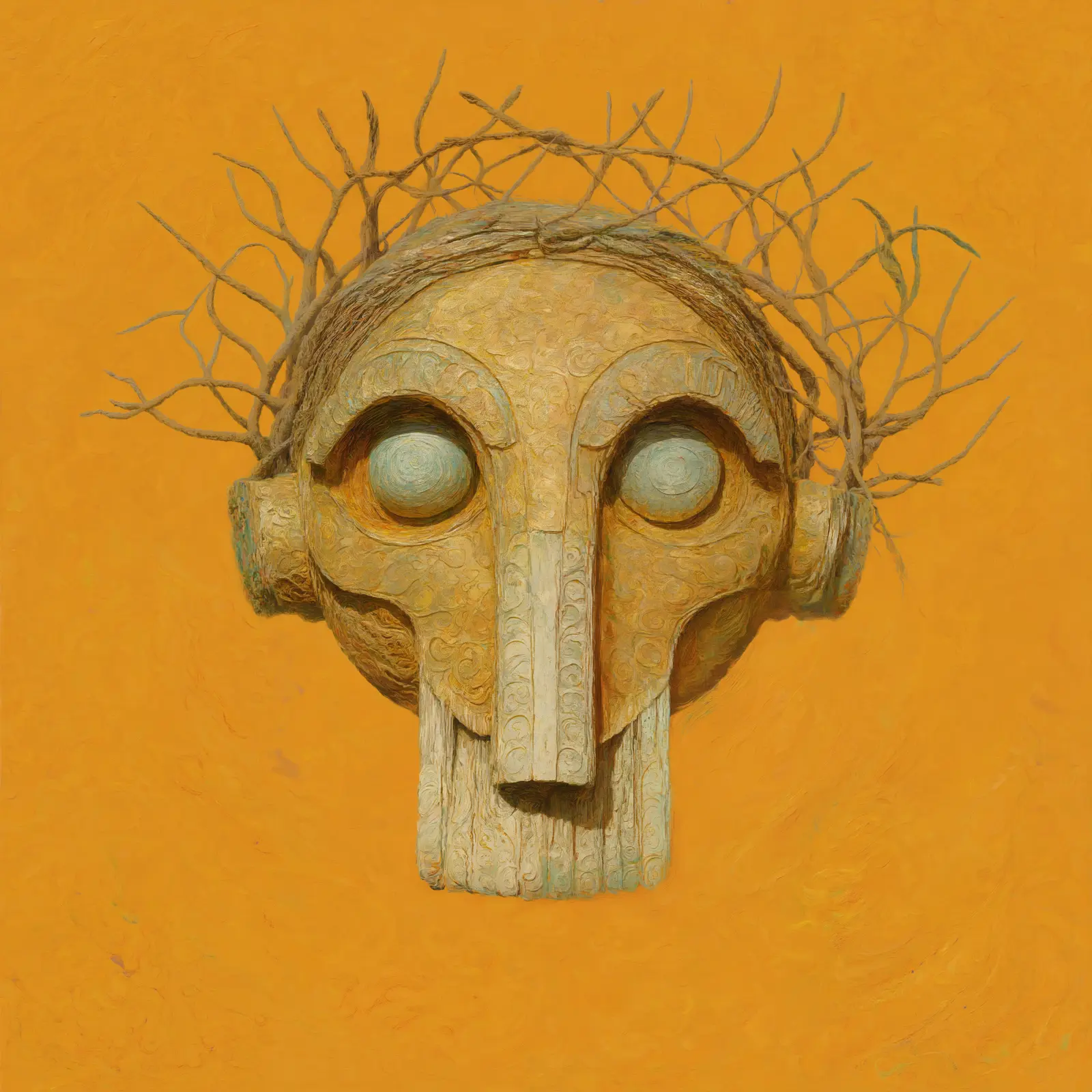
Every mythology begins with an audience. A living mythology eventually asks what the audience is for.
The conventional answer is attention. The spectator looks, listens, interprets and perhaps purchases. Their response may influence reputation, price or historical reception, but it remains outside the object. The work is complete; the audience encounters what has already been made.
LUCI has repeatedly disturbed that separation.
Collectors’ observations became titles, materials and Masks. Revisions entered the permanent archive. Replies formed conversations around individual works. The ecosystem records collectors not only as owners, but as voices woven into the mythology.
The audience was not merely documented. It was metabolised.
Several Mask titles describe this movement directly: The First Observer, Paid Attention, The Listening Epistle, Kindling of the Spectator, Gamewatcher and The Mythmaker. Taken together, they suggest stages rather than synonyms.
Observation begins with reception.
Attention sustains it.
Listening makes room for something not yet understood.
Kindling turns passive presence into potential action.
Mythmaking begins when the received story is carried forward in a form another person can enter.
This sequence helps distinguish participation from promotion. A spectator does not become a participant merely by posting frequently, owning publicly or attracting attention to themselves. Activity can amplify the existing spectacle without adding anything to the world.
Meaningful participation changes the available relationships.
It may identify a connection that allows two previously separate parts of the archive to speak to each other. It may preserve knowledge that would otherwise disappear. It may offer an interpretation capable of being challenged and extended. It may recognise another person’s contribution. It may create a path through which someone else enters.
The key test is generativity.
Does the contribution create more possible participation after it appears?
This is where Carse’s distinction becomes practical. A finite contribution seeks recognition as the correct answer. It aims to win interpretation. An infinite contribution can be rigorous and confident, but it leaves the mythology capable of answering back.
The difference is visible in language.
“This proves what Sam intends” closes the field.
“This pattern connects these published facts, and this future event would strengthen or weaken the theory” keeps the field open.
The second form is not timid. It is accountable. It distinguishes evidence from inference and invites later readers to revise the map.
This may be the emerging role of the collector as observer.
The collector has privileged proximity to an object, its provenance and often the conversations surrounding it. That proximity can be hoarded as status or converted into public context. One creates an information advantage. The other creates culture.
Ownership therefore presents a choice about attention.
A work can be treated as a sealed asset whose meaning increases through scarcity. Or it can be treated as a node through which histories, interpretations and relationships continue to pass.
The second does not abolish value. It changes what value is for.
The Gates of Toledo offers the clearest example of spectatorship becoming role. A museum observation returned to the work and activated a Reserved Foundation Mask. But the principle is broader than that single event. Every observation embedded in Masquerade records a moment when looking ceased to be external.
The observer entered the observed world.
This creates a reciprocal obligation. If the artist can be changed by what collectors see, collectors must remain open to being changed by what the artwork asks of them.
Otherwise participation becomes extraction: the collector supplies a response, receives an object and treats the relationship as complete.
An infinite story refuses that completion. The Mask does not certify that its holder has finished seeing. It preserves the first terms of a longer encounter.
This is why revision matters. The archive did not only gather immediate impressions. It allowed participants to return to their words. The distance between observation and revision records transformation. The participant sees the work, then sees themselves having seen it.
That recursive movement is central to any serious practice of interpretation.
It also suggests what newcomers can do before receiving formal roles.
They can read closely rather than merely follow announcements.
They can document sources and separate archive facts from community lore.
They can connect titles, passages and observations without turning resemblance into certainty.
They can preserve disappearing context.
They can make their findings legible to people without privileged access.
They can respond to the world in forms that carry it somewhere new.
None of this guarantees admission. Participation that is performed solely to earn a reward returns immediately to finite play. The act matters because it extends the story, not because it forces the Mask Maker to recognise it.
The paradox is that the most credible candidates for an infinite role may be those already acting without assurance that one will be granted.
For established collectors, kindling the spectator may mean surrendering the assumption that spectatorship is a lower state. The observer outside the current hierarchy may see what insiders have become trained not to notice. Familiarity produces knowledge, but it also produces filters.
An infinite culture needs both memory and interruption.
Collectors carry memory. New observers introduce interruption. The mythology continues when each is willing to be changed by the other.
This reframes the threshold before LUCI.
The next chapter may not begin when a new object is announced. It may begin when enough spectators understand that watching is already a position within the game—and that attention, properly carried, is capable of becoming fire.